Jacob Waltz and the Elusive Lost Dutchman Mine
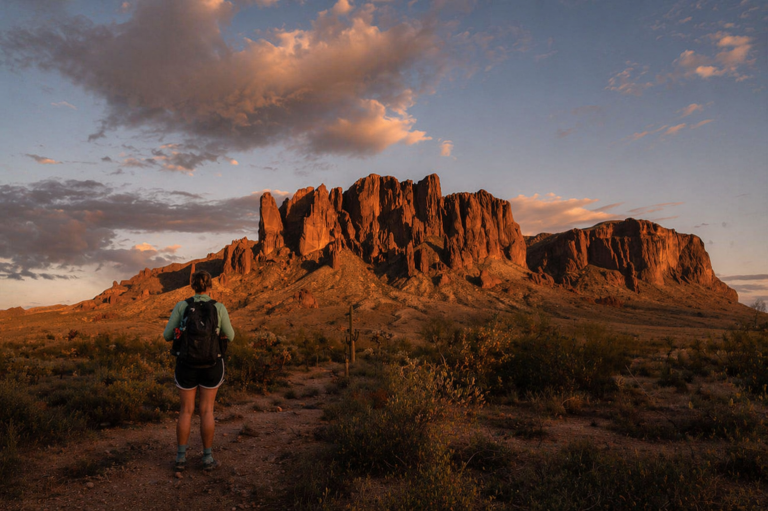
Somewhere in the Superstition Mountains east of Phoenix, Arizona, there may or may not be a gold mine. Nobody has ever found it and nobody can prove it even exists. And yet people have been searching for it for well over a century, some of them dying in the process.
This is the story of Jacob Waltz, or as close to the truth as the historical record gets.
Before Waltz
The story does not begin with Waltz. It begins earlier, with a Mexican family named Peralta.
According to accounts passed down through the years, the Peralta family of Sonora, Mexico worked a rich gold mine somewhere in the mountains that are now called the Superstitions. They sent expeditions north regularly, loading burros with ore that required nothing but a hammer to break from the quartz. The mine was reportedly that rich.
Then came the Mexican War and the boundary shift that put those mountains inside United States territory. The Peraltas, believing they had lost their legal claim to the land, made one final expedition north. On the northwestern flanks of the Superstitions, the party was attacked. Most of them were killed. A few survivors made it back to Mexico.
The Peraltas had no reason to write the location down. It was family knowledge, passed from person to person. When the survivors fled back to Mexico, they took what they remembered with them. The mine, as far as anyone outside the family knew, simply ceased to exist.
The Man Himself
Jacob Waltz was born in Germany, probably around 1808. He is almost universally called the Dutchman, though he was not Dutch. In the 19th century, the word Dutch was commonly used in America to describe Germans as well as those from the Netherlands. He came to the United States in the 1840s, worked mines in North Carolina and Georgia, made his way to California, and was naturalized as an American citizen in 1861. By 1864 he was in Arizona Territory, living in the Walker mining district near Prescott.
He was not what anyone would call a romantic figure. People who knew him in Phoenix described him as unhappy, miserly, withdrawn, and kept to himself. He avoided contact with most people and was always suspected of having something to hide. He had a small ranch near the Salt River with a vineyard and an orchard. He minded his own business. He was known to sell gold nuggets on occasion, but he never went into the mountains openly, and he never explained where the gold came from.
He had been a resident of Arizona Territory for decades before anyone outside his small circle paid much attention to him.
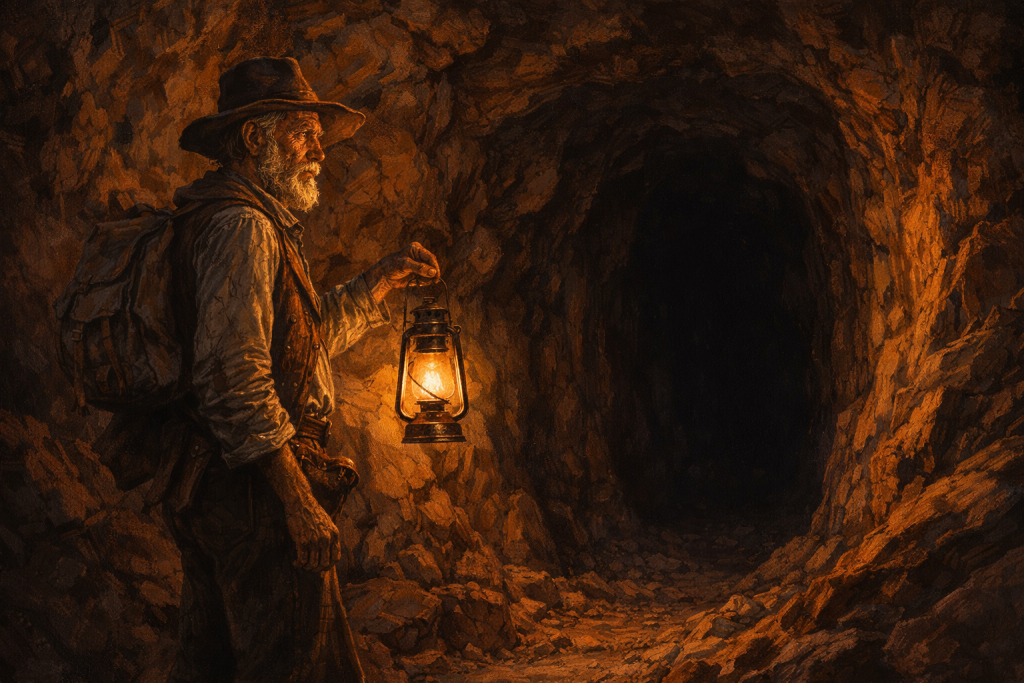
How He Said He Found It
The most detailed early account of Waltz’s story comes from a San Francisco Chronicle article published January 13, 1895, written by a reporter named P.C. Bicknell. It is the article that introduced the legend to the public.
According to Bicknell, Waltz went into Sonora at the start of the Civil War to avoid military service. There, he met the Peralta family, who held a large land grant that was worthless except for the mine. Believing their claim in the United States was lost after the Mexican War, they sold him the information needed to find it for very little money.
Waltz returned to Arizona with a partner, another German also named Jacob. Following directions the Peralta family had provided, the two men made their way into the Superstitions, starting from the first gorge on the south side from the west end of the range. A marked trail led them northward over a ridge, down past a prominent butte the Mexicans called El Sombrero, along a long canyon, and finally into a tributary canyon that was deep, rocky, and densely wooded with scrub oak.
As they got closer to their destination, they realized they were not alone.
About 100 feet up a steep slope they spotted two men breaking rocks. They believed these men would stop them from claiming the mine. They each picked a man and they both fired shots at them. When the smoke cleared, two more men came out of the mine shaft below and they killed those men as well. Then two more appeared. By the time it was over, six men were dead.
When they examined the bodies, they realized what they had done. They were Mexican laborers, working the mine for the Peralta family. Waltz and his partner had just murdered six men in cold blood.
They took what gold they could carry, covered the mine, and planned to leave and return later. The shaft, according to Bicknell’s account, was about 75 feet deep, cut into the rock with handholds carved into the walls.
Waltz went to Tucson for supplies. When he returned, his partner was dead, killed by Apaches. Waltz dragged the body into the tunnel they had made, sealed it up, and left.
No one ever saw him go back. Not once in the years that followed did he mount a proper expedition to recover the gold. He believed the spot was haunted. His neighbors said he saw ghosts, and that people passing his cabin at night heard him speaking in low, frightened tones, as though addressing someone who was not there.
The End of the Dutchman
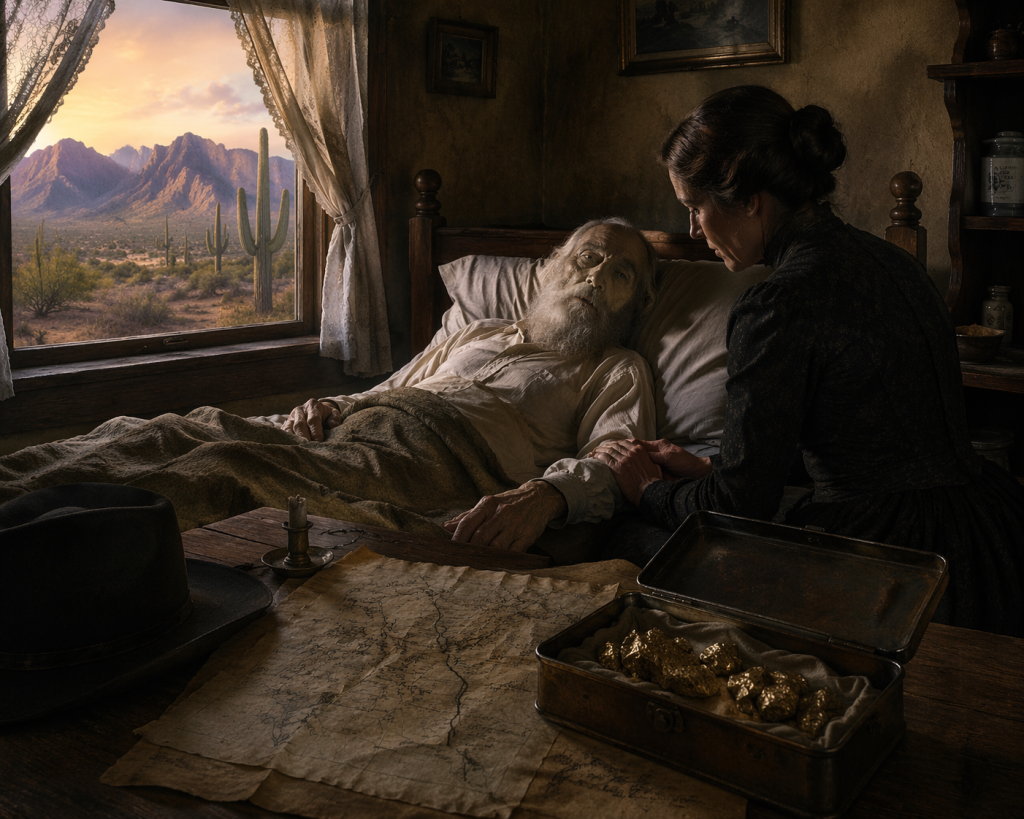
By October 1891, Jacob Waltz was dying. He was taken in by a woman named Julia Thomas, who owned a confectionery shop in Phoenix and had befriended him in his final years. Over time he had paid her in gold nuggets, totaling somewhere around $1,500, in exchange for help handling his finances.
Waltz died in her home on Sunday morning, October 25, 1891. He was somewhere in his early eighties. The exact age is uncertain because records from his German birthplace were never found.
At some point during his final days, he told Julia Thomas how to find the mine. He gave her directions. He also left her a candle box containing nearly 50 pounds of high-grade gold ore, found under his bed after his death.
His directions, it turned out, were either incomplete, or she got them mixed up.
Thomas sold everything she had and mounted an expedition with two brothers she enlisted as partners. They searched through the hot summer months of 1892 following Waltz’s instructions through the brutal terrain. They found nothing. Thomas came back to Phoenix destitute. The brothers quarreled and parted ways, each spending the rest of his life hunting for the mine separately.
Thomas eventually sold copies of her maps and directions to anyone willing to pay. The story spread from there, prospector to prospector, until Bicknell put it in the San Francisco Chronicle in January 1895. That newspaper article, Superstition Mountains historian Tom Kollenborn has noted, is where the public legend of the Lost Dutchman truly begins. Almost no one had heard of Jacob Waltz before that story ran.
Two weeks later, a different San Francisco Chronicle piece referenced the Lost Dutchman mine in passing, treating it as an established fact already familiar to readers. The legend had its legs.
What the Record Actually Says
Waltz left no written account of the mine. Everything attributed to him comes through other people, primarily Julia Thomas, who told her story to Bicknell, who published it four years after Waltz died. The chain between the original event and the written record is long, and at every link in that chain someone is relying on memory or hearsay.
Geologists have almost universally dismissed the idea of a significant gold-bearing ore mine inside the Superstition Wilderness Area. The government bases its position on extensive geologic research within the boundaries of the region. Gold was found at Goldfield, at the base of the mountains, but that is a different thing from a rich mine hidden somewhere inside the range itself.
There are also multiple versions of the story and always have been. Some say Waltz and his partner stumbled on a Peralta cache rather than a working mine. Some say Waltz killed his partner, not the Apaches. Some say instead of a mine there was simply a large quantity of already-extracted ore hidden in the mountains. Bicknell himself went looking for the rock cabin that Waltz described as a landmark and found a cave that matched the description, but no mine on the opposite side of the canyon.
None of that has slowed anyone down.
The Last Man Who Knew Him
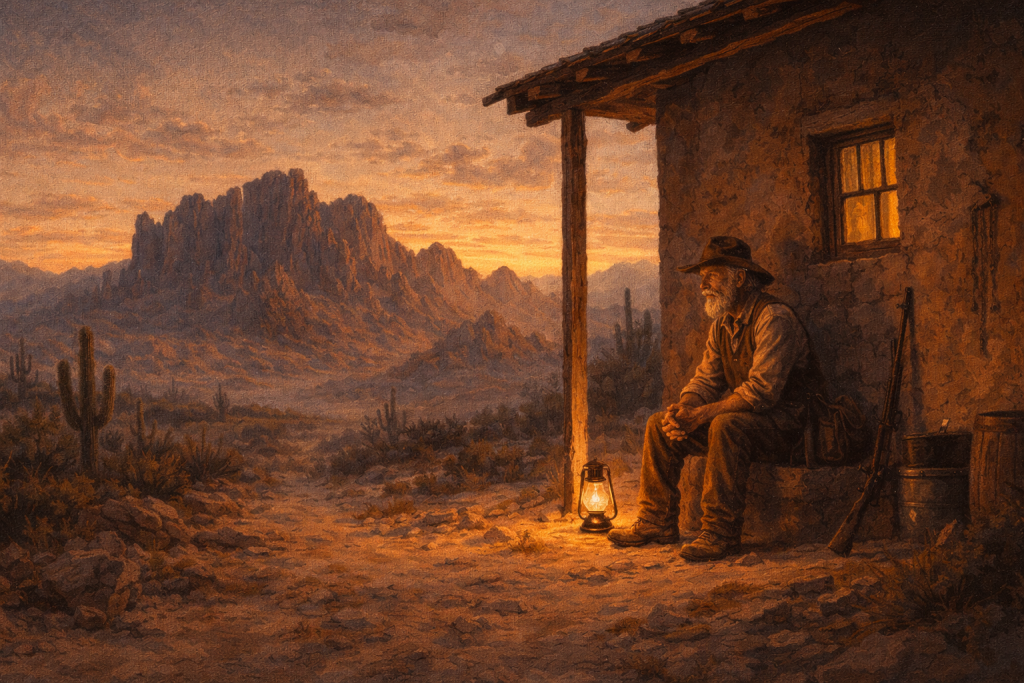
George “Brownie” Holmes was born in Phoenix in 1892, the year after Waltz died. His family had known Waltz personally. Holmes spent forty years searching for the mine. He didn’t write any books, didn’t give any interviews, and avoided arguments about whether the mine existed. He was only mildly discouraged by his inability to find it. He remained convinced of its existence until the end of his life.
Holmes died on April 11, 1980, on the morning of his 88th birthday. He left instructions that no services be held and that after his cremation his ashes be scattered in the Superstition Mountains.
The following morning, a lone rider saddled up at the First Water trailhead, loaded a pack horse, and rode east toward a grassy knoll hidden deep in the mountains. Brownie Holmes was going home.
The mine has not been found. Most geologists say it never existed in the way the legend describes. Historians can trace the public version of the story back to a single newspaper article published four years after the man it was about had already died.
And still, every year, people go looking. And every year, some don’t come back. The story of the Superstition Mountains didn’t end with Jacob Waltz. In fact, it was the beginning of strange deaths and missing people that have left authorities baffled.
The next story in the series is Dead in the Superstition Mountains.
Debbie Campbell Fowler is the author of Waco Hauntings: and Other Tales from the Heart of Texas and co-founder of Atomic Clockwork Publishing.
Illustrative images in this post are AI-generated.
Sources
San Francisco Chronicle, January 1895. Two articles covering the Lost Dutchman Mine legend, including P.C. Bicknell’s original account published January 13, 1895.
Arizona Republic, multiple dates 1972-2007. Articles covering the history of Jacob Waltz and the Lost Dutchman legend.
Kollenborn, Tom. “Waltz’s Gold Mine,” 2000, and “Superstition Mountain,” 2001. Superstition Mountain Historical Society and Apache Junction Public Library Local History Collection.