The Man in the Hebrew Cemetery
There’s a grave in Corsicana, Texas that has puzzled people for more than a hundred years. The headstone doesn’t have a name on it. It doesn’t have a birth date or a hometown or a biblical verse. It has two words.
Rope Walker.
What happened
On a sunny afternoon in 1884, a man climbed to the roof of a building on Beaton Street in downtown Corsicana. He was about forty years old, gray-eyed, with substantial sideburns. He had one leg. The other had been replaced by a wooden peg leg with a notch carved in the bottom to help him grip a rope.
He strapped a heavy iron stove to his back.
Then he started walking a tightrope stretched thirty feet above the street to the roof of the building across the way.
People came from all over to watch. Practically everyone in town lined the sidewalks. This was 1884. There was no television, no radio, no movie theater. A one-legged man crossing a tightrope with a stove on his back was about as good as entertainment got.
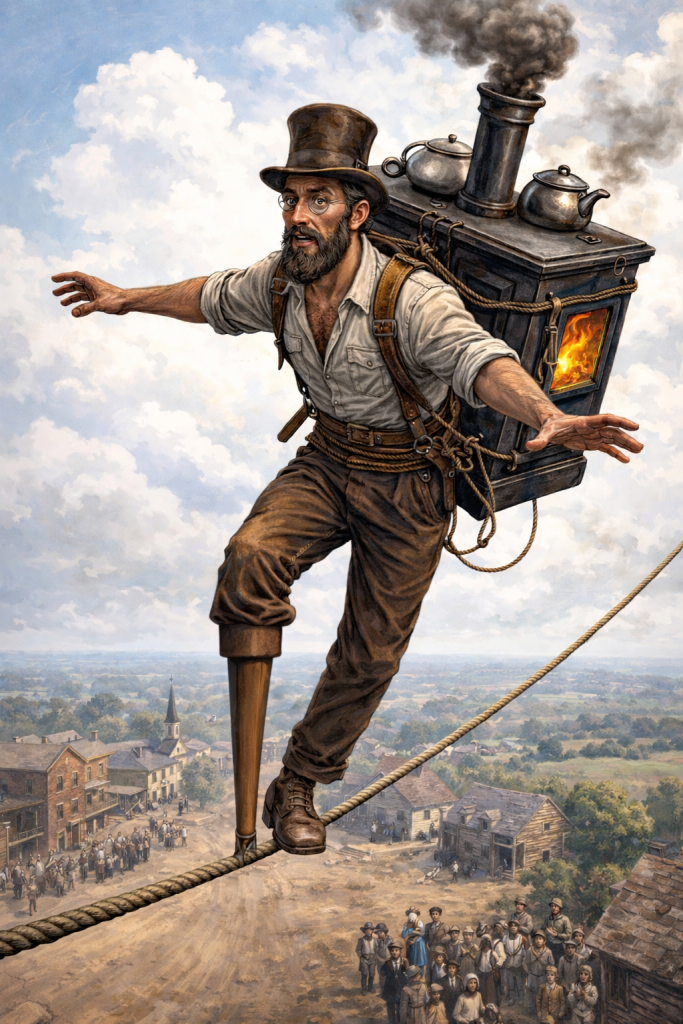
He made it about halfway across before he lost his balance. His notched peg leg slid. His good leg swung free. He fell thirty feet and landed with the cook stove crushing down on top of him.
The crowd surged forward. Men carried him to the nearby hotel. A doctor was summoned. Women and children scattered to nearby stores for protection while the men tried to figure out what to do.
As he lay dying, the man asked for a minister. He said he was Methodist. The famous evangelist Abe Mulkey came and prayed with him. But then the man corrected himself. He wasn’t Methodist. He was Jewish. There was no rabbi in Corsicana at the time, so a Jewish merchant named Bernard Simon came to his side and prayed with him in Hebrew.
Through all of this, the man refused to give his name. He wouldn’t say where he was from. He wouldn’t say if he had family. Multiple people asked him, and he refused every time. He died that evening, still unnamed.
The Jewish community of Corsicana buried him in their cemetery. They put a small marble headstone at his grave. It said: Rope Walker.
A Century of Questions
The story showed up in the Corsicana Daily Sun in 1936, fifty-two years after the fact, when a woman named Rachel London gave a detailed account of what she had witnessed as a girl. Her father, Max London, had been the cemetery’s administrator and a Confederate veteran who was there the day it happened. The story kept getting retold. Noted Texas historian Frank X. Tolbert wrote about it in the Dallas Morning News in the 1950s and 60s. It resurfaced at least once every decade.
Nobody figured out who he was.
Theories piled up over the years. He was a stove salesman using the stunt as advertising. He was a circus performer who had fallen on hard times. He was a drifter with a death wish. None of it could be confirmed. The Texas Historical Commission put a marker at the Hebrew Cemetery in 2008 that described his story as one that had gripped the community for generations. The grave was still marked with two words and nothing else.
The Man Who Solved It
Jim Yarin is a genealogist from Massachusetts who came across the Rope Walker story while researching a Corsicana family about fifteen years ago. Something about it got under his skin. He spent the next five years digging through courthouse records, ship manifests, vintage newspaper databases, and archival collections trying to find an answer that a century of local searching had missed.
He found something remarkable in Corsicana’s own courthouse records. He found a reference to the accident that gave a name to an injured man whose leg was amputated, described as an indigent person. Somehow, despite years of searching, nobody had found it.
What Yarin eventually pieced together was the story of a man who had toured the United States from 1868 to 1883 performing under two names, Professor Daniel De Houne and Professor Moses Berg. Berg was the real name. De Houne was the stage name. Before the Civil War, he had immigrated to Texas from Berlin, where he had performed with a circus for thirteen years. He lost his leg at the Battle of Middleburg in 1862 while fighting with the Kansas 7th Cavalry. After the war, with a wife and six children to support back in Texas, he went back on the road, swallowing swords, performing on a trapeze, and walking tightropes in towns across the country.
Yarin published his findings in a nearly 400-page book called Rope Walker, A Texas Jewish History Mystery. It’s meticulously documented with 1,126 footnotes, two indexes, three appendixes.
Not everyone accepted his conclusion. Babbette Samuels had been caring for the Corsicana Hebrew Cemetery since the 1990s. She personally replaced the original vandalized marble marker with a sturdier granite one. She was unmoved by Yarin’s research. If this man had a wife and six children in Texas, she argued, his dying words would have mentioned them. No family member ever came forward. Nobody ever claimed him.
“He will always be Rope Walker,” she said.
Why This Story Stays With Me
When I first read the story of the Rope Walker, I was baffled that anyone could be so confident they could strap a stove to their back and walk a tightrope with a peg leg. The outcome wasn’t surprising, but the fact that he believed he could do it is what stuck with me.
He walked into Corsicana as a stranger. He performed in front of a crowd, fell thirty feet, died in a hotel room, and left behind nothing but two words on a headstone. He kept his name to himself even as he was dying, which is one of the strangest things I’ve come across in all my years of digging through old records.
Was he Moses Berg? Maybe. Was he someone else entirely? Possibly. But here’s what I keep coming back to. The grave is still there, with two words on the headstone, and more than 140 years later, people still stand in front of it trying to understand how a man can die in full view of a town and remain a complete mystery.
That’s haunting enough for me.
The Corsicana Hebrew Cemetery is located at 2400 West 3rd Avenue in Corsicana. The Rope Walker’s grave is in the southern section. If you go, you’ll find it. You’ll know it when you see it.
Debbie Campbell Fowler is the author of Waco Hauntings: and Other Tales from the Heart of Texas and co-founder of Atomic Clockwork Publishing.
Illustrative images in this post are AI-generated.
Sources
D Magazine Staff. “The Mysterious Story of the One-Legged Jewish Rope Walker.” D Magazine. April 7, 2021.
Fowler, Gene. “The Rope Walker of Corsicana.” Texas Co-op Power. February 2018.
John Sam Haslam. “Identity of “Rope Walker” Killed Here 52 Years Ago Remains Unsolved Mystery.” Corsicana Daily Sun, 1936.