Connally Air Force 1950 UFO Sighting
The Report Filed in Waco
Seven miles north of Waco, Texas, sat Connally Air Force Base, a military installation built for training pilots. In the spring of 1950, something unusual passed through its paperwork.
It started in the sky over New Mexico.
What He Saw
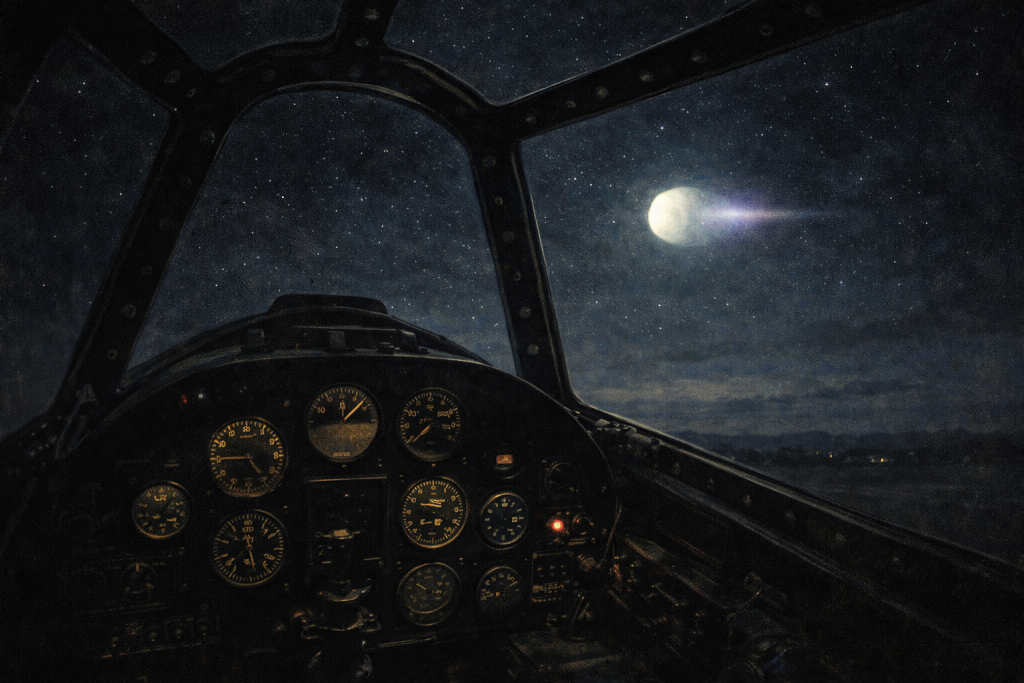
On the morning of March 20, 1950, 1st Lieutenant Charles O. Wiedman was flying a T-6 aircraft from Albuquerque, New Mexico to Lubbock, Texas. It was just after 1:00 in the morning, Mountain Time. He had just taken a radio compass fix and established his position as 35 miles southeast of Clovis, New Mexico, when something appeared at his eleven o’clock.
It was white. Luminous. Spherical.
It was moving at an estimated speed of 2,000 miles per hour.
The object passed his aircraft and disappeared behind the ship in a matter of seconds. As it crossed his left side, Wiedman noticed it seemed to change shape, stretching from a sphere into something elongated. The rear section glowed a light bluish lavender. Behind it, a visible stream of matter trailed through the air like a vapor trail.
He was flying at 9,500 feet. The object was several thousand feet above him.
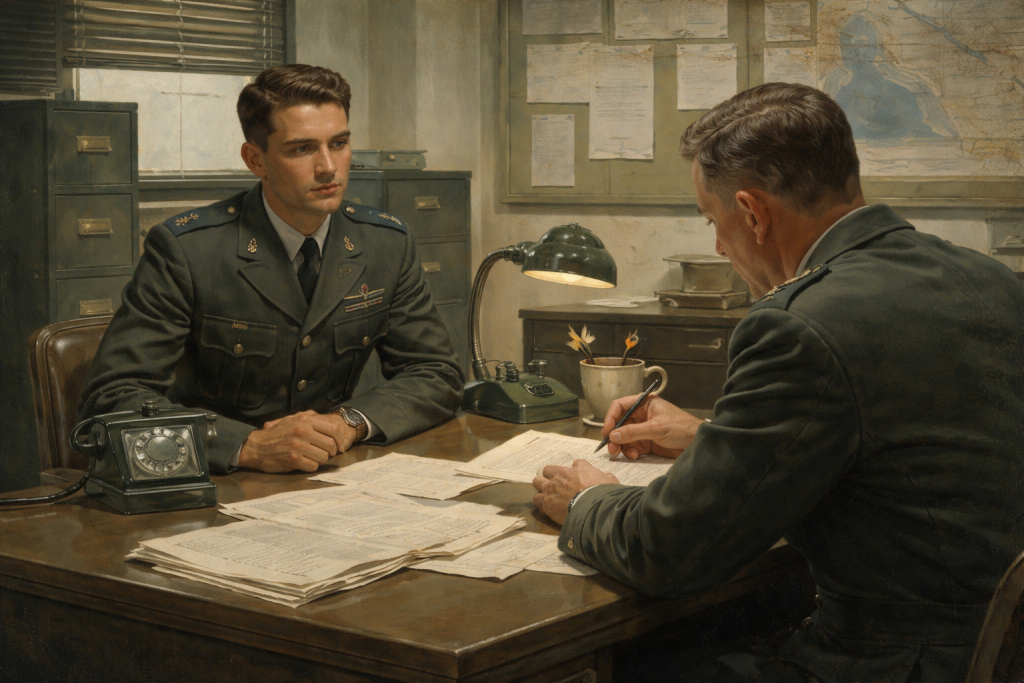
Four days later, on March 24th, Lieutenant Wiedman walked into the office of the Connally Air Force Base Detachment, 10th District OSI, in Waco, Texas, and filed a formal report.
What Waco Did With It
The OSI office at Connally did not file the report and move on. They wrote to Air Force intelligence in Washington asking for guidance, noting that a current estimate of unconventional aerial phenomena would help them better direct future reporting from OSI district offices.
Washington wrote back. The response was careful and bureaucratic. A directive issued in January 1950 had already cancelled all special orders for collecting information on unconventional aerial objects. From now on, such reports should be treated the same as any other intelligence matter.
In other words, handle it. Don’t make a fuss.
The formal language doesn’t quite hide what was happening. A military pilot had reported something traveling at 2,000 miles per hour over New Mexico, and the OSI office in Waco was rattled enough to ask Washington what to do about it.
The Bigger Picture
Wiedman’s sighting was not happening in a vacuum. The spring of 1950 was one of the most active periods for UFO reports in American history. Just days before his sighting, two commercial airline pilots named Adams and Anderson reported a large craft with glowing ports on its underside crossing in front of their Chicago and Southern flight over Arkansas. The story went national. Mrs. Eleanor Roosevelt invited them on television. Commentators Walter Kiernan and Drew Pearson both weighed in on the UFO mystery.
The Air Force had officially closed Project Grudge, its UFO investigation program, in December 1949, and declared there was nothing to investigate. Reports kept coming in anyway, from military personnel, commercial pilots, and civilians across the country and around the world.
Wiedman’s report is noted in historian Loren E. Gross’s documented history of UFO sightings from this period. Gross described the Connally OSI office’s reaction as almost certainly understated by the formal language of the official record.
What the Base Became
Connally Air Force Base was formally renamed James Connally Air Force Base in 1950, in honor of James T. Connally, a Waco native killed when his aircraft was hit by artillery during a bombing raid over Japan in World War II. The base continued operating through the 1950s, training navigators, radar observers, and pilots from the United States and other countries. It closed as a military installation in the mid-1960s. The state of Texas purchased the property, and it eventually became Texas State Technical College, which operates there today.
Most people who pass through that campus have no idea that in March 1950, a military pilot walked into a building on those grounds and told someone in an official capacity that he had seen something in the sky over New Mexico that he could not explain.
The report exists. The request for guidance exists. The response from Washington exists.
What Wiedman saw over the desert that morning in 1950 was never officially identified.
Debbie Campbell Fowler is the author of Waco Hauntings: and Other Tales from the Heart of Texas and co-founder of Atomic Clockwork Publishing.
Illustrative images in this post are AI-generated.
Sources
Gross, Loren E. UFOs: A History, 1950: January through March. Fremont, California, 1983.
Miller, Sarah. “James Connally Air Force Base.” Waco History, Baylor University. wacohistory.org/items/show/167.